I. From the Perspective of the Product Itself
(1) Specification Parameters
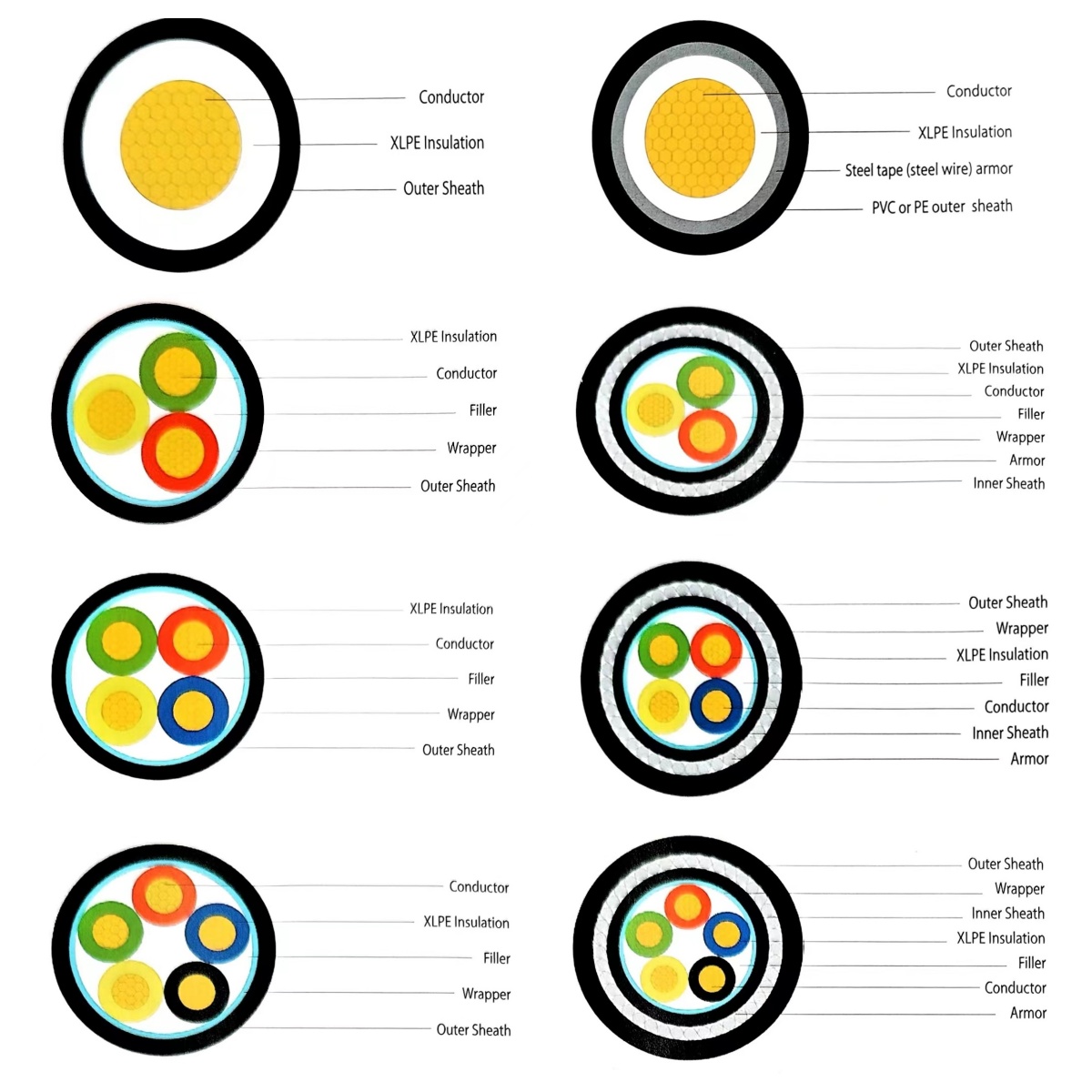
The N2XH-J and N2XH-O series of flame-retardant low-smoke zero-halogen (LSZH)
Power Cables have rigorous and comprehensive specification parameters, which can accurately meet the power transmission requirements of different high-safety-demand scenarios.
Both cables have a rated voltage of 0.6/1kV, a voltage level that makes them suitable for medium and low-voltage power distribution systems and widely applicable to various places with high safety requirements. The cross-sectional range covers 4mm² to 240mm², and cables with different cross-sections have distinct performance parameters.
For the 4mm² cable, the conductor diameter is approximately 2.25mm, the overall outer diameter is about 8.5mm, and the weight per meter is about 0.12kg. When laid in the air, the current-carrying capacity is approximately 36A; when laid underground, it is about 45A.
For the 6mm² cable, the conductor diameter is about 2.76mm, the overall outer diameter is about 9.2mm, and the weight per meter is about 0.16kg. The current-carrying capacity when laid in the air is about 46A, and when laid underground, it is about 58A.
For the 10mm² cable, the conductor diameter is about 3.58mm, the overall outer diameter is about 10.8mm, and the weight per meter is about 0.23kg. The current-carrying capacity when laid in the air is about 64A, and when laid underground, it is about 80A.
For the 16mm² cable, the conductor diameter is about 4.51mm, the overall outer diameter is about 12.5mm, and the weight per meter is about 0.32kg. The current-carrying capacity when laid in the air is about 85A, and when laid underground, it is about 106A.
For the 25mm² cable, the conductor diameter is about 5.64mm, the overall outer diameter is about 14.2mm, and the weight per meter is about 0.45kg. The current-carrying capacity when laid in the air can reach 130A, and when laid underground, it reaches 160A, which can meet the power supply needs of medium and high-power equipment.
For the 35mm² cable, the conductor diameter is about 6.68mm, the overall outer diameter is about 15.8mm, and the weight per meter is about 0.58kg. The current-carrying capacity when laid in the air is about 138A, and when laid underground, it is about 173A.
For the 50mm² cable, the conductor diameter is about 7.98mm, the overall outer diameter is about 17.5mm, and the weight per meter is about 0.75kg. The current-carrying capacity when laid in the air is about 175A, and when laid underground, it is about 219A.
For the
70mm² Cable, the conductor diameter is about 9.48mm, the overall outer diameter is about 19.5mm, and the weight per meter is about 0.98kg. The current-carrying capacity when laid in the air is about 220A, and when laid underground, it is about 275A.
For the 95mm² cable, the conductor diameter is about 11.06mm, the overall outer diameter is about 21.5mm, and the weight per meter is about 1.25kg. The current-carrying capacity when laid in the air is about 265A, and when laid underground, it is about 331A.
For the 120mm² cable, the conductor diameter is about 12.34mm, the overall outer diameter is about 23.0mm, and the weight per meter is about 1.50kg. The current-carrying capacity when laid in the air is about 310A, and when laid underground, it is about 388A.
For the 150mm² cable, the conductor diameter is about 13.80mm, the overall outer diameter is about 25.0mm, and the weight per meter is about 1.80kg. The current-carrying capacity when laid in the air is about 355A, and when laid underground, it is about 444A.
For the 185mm² cable, the conductor diameter is about 15.10mm, the overall outer diameter is about 27.0mm, and the weight per meter is about 2.15kg. The current-carrying capacity when laid in the air is about 400A, and when laid underground, it is about 500A.
For the 240mm² cable, the conductor diameter is about 17.00mm, the overall outer diameter is about 29.5mm, and the weight per meter is about 2.65kg. The current-carrying capacity when laid in the air is about 470A, and when laid underground, it is about 588A.
The core number design covers 1-
5 Cores. 1-
Core Cables are suitable for single-phase high-voltage power transmission or grounding systems; 2-core cables are often used in single-phase power and lighting circuits; 3-core cables are widely used in three-phase AC power supply systems; 4-core and 5-core cables integrate neutral wires or
Grounding Wires, suitable for complex systems that need to transmit power and ensure safe grounding at the same time.
In terms of electrical performance, the insulation resistance of the XLPE insulation layer is ≥1000MΩ·km, the dielectric loss is ≤0.002, and it can withstand a 10kV power frequency withstand voltage test without breakdown. The volume resistivity of the HFFR sheath is ≥1×10¹⁴Ω·cm, with good insulation performance.
In terms of mechanical performance, both cables have a tensile strength of ≥12MPa and an elongation at break of ≥150%. Among them, due to the addition of enhanced wear-resistant agents in the sheath, the tensile strength of N2XH-J is slightly higher than that of N2XH-O, reaching more than 13MPa. In terms of bending radius,
Single-Core Cables are not less than 12 times the cable outer diameter, and
Multi-Core cables are not less than 10 times the cable outer diameter.
In terms of flame retardant performance parameters, the oxygen index of the HFFR sheath is ≥35%, which meets the Class C and above requirements in the GB/T 18380.3-2008 flame retardant standard. In the vertical burning test, the flame spread length is ≤500mm, and there are no drips to ignite the combustibles below. In terms of smoke density, the minimum light transmittance is ≥60%, and the HCl emission is ≤5mg/g.
In terms of temperature resistance, the normal operating temperature of the cable is -40℃ to 90℃. In case of a short circuit, the maximum operating temperature can reach 250℃ for no more than 5 seconds.
(2) Characteristic Uses
The N2XH-J and N2XH-O series cables, with their excellent flame retardant, low-smoke zero-halogen characteristics and stable performance, have distinctive applications in many high-safety-demand fields.
The subway system is one of the important application scenarios for these two cables. The subway tunnel has a closed space and dense personnel, and a fire, if it occurs, can have disastrous consequences. The N2XH-J cable, with its excellent mechanical damage resistance, is suitable for use in the bridge laying of subway tunnels, providing stable power for the train's traction system, lighting system, and ventilation equipment. The N2XH-O cable can be used in the outdoor parts of subway stations, such as the power supply for lighting and monitoring equipment at the entrances and exits, and its good weather resistance can adapt to outdoor wind, sun, and rain. In the fire protection system of the subway, both cables can be used as special cables for emergency lighting and fire pumps to ensure the continuous operation of key equipment in case of fire, gaining time for passenger evacuation.
The field of high-rise buildings has extremely high requirements for cable fire safety, and the N2XH-J and N2XH-O cables play an important role here. In the shafts and cable wells of high-rise buildings, the flame retardant performance of cables is crucial, and these two cables can effectively prevent flames from spreading along the cables and delay the expansion of the fire. For open laying lines inside the building, such as lighting and
Emergency Power Supply lines in corridors and stairwells, the N2XH-J cable is the first choice due to its strong mechanical damage resistance. In the outdoor parts of the building, such as air conditioning equipment on the roof and lighting for billboards, the weather resistance advantage of the N2XH-O cable is reflected, and it can work stably for a long time. In addition, places such as hospitals and hotels in high-rise buildings have strict requirements for low-smoke zero-halogen characteristics, and the low-smoke and non-toxic characteristics of the two cables when burning can ensure the safety of personnel in case of fire.
Hospitals are another place with strict requirements for cable safety performance. Critical areas such as operating rooms and ICU wards need reliable and safe power supply. The N2XH-J cable can be used as the power supply trunk for these areas. Its pure
Copper Conductor's stable conductivity ensures the normal operation of medical equipment, and its low-smoke zero-halogen characteristics avoid the harm of toxic gases to patients and medical staff in case of fire. The fire protection system of the hospital, such as sprinkler pumps and smoke exhaust fans, also relies on these two cables for power supply to ensure their operation in emergencies. In areas with special environmental requirements such as the radiology department of the hospital, the chemical corrosion resistance of the cable can also meet the usage needs.
Data centers, as the core of information storage and processing, have extremely high requirements for the stability and safety of power. In the wiring of data center computer rooms, a large number of servers, switches and other equipment need continuous power supply, and the N2XH-J and N2XH-O cables can provide stable power transmission. Their low-smoke characteristics can avoid the risk of "black smoke asphyxiation" in case of fire, protect precision equipment, and reduce losses. At the same time, the power supply lines of air conditioning systems, UPS uninterruptible power supplies and other equipment in data centers can also use these two cables to ensure the normal operation of data centers.
Chemical places have a certain corrosive environment and have high requirements for the
Chemical Resistance of cables. The HFFR sheaths of N2XH-J and N2XH-O cables have passed acid and alkali resistance tests. After being immersed in a solution with a pH value of 2-12 for 72 hours, the volume resistivity change rate is ≤20%, which can be used in the power distribution system of chemical places to provide power support for various chemical equipment.
In addition, the two cables are also widely used in crowded places such as large stadiums, airports, and railway stations. In the lighting systems, security systems, broadcasting systems, etc. of these places, the safety and stability performance of the cables are fully exerted, ensuring the normal operation of the places and the safety of personnel.
(3) Material and Style
The N2XH-J and N2XH-O series cables focus on the combination of safety, reliability and environmental adaptability in material selection, and their style design also fully meets the installation needs of different scenarios.
The conductor is made of pure copper with a purity of ≥99.95%. This high-purity copper has excellent electrical conductivity with a conductivity of 102% IACS, which can effectively reduce energy loss during power transmission and improve transmission efficiency. Pure copper also has good ductility and toughness, which is convenient for processing into conductors of various specifications during production, and can withstand a certain amount of bending and stretching during laying, not easy to break, ensuring the service life of the cable.
The insulation layer is made of cross-linked polyethylene (XLPE) material. Through cross-linking technology, polyethylene molecules form a three-dimensional network structure, which greatly improves the performance of the material. The XLPE insulation layer has a wide temperature resistance range of -40℃ to 90℃, and can maintain stable insulation performance in extreme temperature environments. Its insulation resistance is ≥1000MΩ·km, and the dielectric loss is ≤0.002, with excellent insulation performance, which can effectively block current leakage and ensure the safety of power transmission. Compared with ordinary polyvinyl chloride
Insulation Materials, XLPE has better aging resistance and a longer service life, and can adapt to long-term use needs.
The sheath is made of high flame-retardant fire-resistant (HFFR) material, which is the key for the two cables to achieve flame-retardant, low-smoke and zero-halogen characteristics. The HFFR sheath has an oxygen index of ≥35%, with excellent flame retardant performance, which can inhibit the spread of flames in case of fire. At the same time, it releases low smoke density (minimum light transmittance ≥60%) when burning and does not release toxic gases such as hydrogen halide (HCl emission ≤5mg/g), meeting environmental protection and safety requirements.
There are slight differences in the sheath materials of N2XH-J and N2XH-O cables. The sheath of N2XH-J is added with enhanced wear-resistant agents, making its tensile strength ≥13MPa and elongation at break ≥150%, with stronger mechanical damage resistance, suitable for scenarios such as open laying or bridge laying that are vulnerable to mechanical collision. The sheath of N2XH-O is added with anti-ultraviolet additives to improve its weather resistance, which can be used in outdoor exposed environments for a long time. Its aging resistance is more than 30% higher than that of ordinary HFFR materials, and it can resist the impact of natural environments such as direct sunlight and wind and rain erosion.
In terms of style, both cables have armored and non-armored types. Non-
Armored Cables are light in weight and flexible, suitable for indoor laying, pipe laying and other environments, and are easy to install. Armored cables have an additional metal armor layer outside the sheath, usually
Steel Tape armor, which can further improve the cable's resistance to mechanical damage and pressure, and are suitable for scenarios prone to external impact such as underground laying and bridge laying.
In addition, the color of the cable is usually black, which can not only absorb heat, reduce the impact of temperature changes on the cable, but also maintain a good appearance in various environments and is not easy to get dirty. Other colors of sheaths can also be provided according to customer special requirements, but black is the most commonly used choice.
(4) Production Process
The production process of N2XH-J and N2XH-O series cables is complex and precise, and each process is strictly controlled to ensure that the products meet the designed high performance and high safety requirements.
The production process of the conductor starts with the smelting of high-purity electrolytic copper to remove impurities and obtain copper liquid with a purity of ≥99.95%. The copper liquid is made into copper rods through continuous casting, and the diameter of the copper rods depends on the final conductor specifications. Subsequently, the copper rods are drawn through a wire drawing machine in multiple passes to gradually form
Copper Wires of the required diameter. During the wire drawing process, the drawing speed, die precision and cooling system must be accurately controlled to ensure that the copper wires have uniform diameter, smooth surface and good mechanical properties. After wire drawing, multiple copper wires are stranded together according to a certain stranding method to form a conductor. The stranding pitch is strictly controlled according to the cable specifications to ensure the roundness and
Flexibility of the conductor. The
Stranded Conductor needs to be annealed, heated to a certain temperature (usually 300-500℃) and then slowly cooled to eliminate internal stress and further improve the conductivity and flexibility of the conductor.
The extrusion of the insulation layer is one of the key processes. Using cross-linked polyethylene (XLPE) material, first, XLPE particles are added to the extruder and melted and plasticized at high temperature (about 120-150℃). The melted XLPE is uniformly coated on the surface of the conductor through a die to form an insulation layer. During the extrusion process, the extrusion temperature, speed and pressure must be accurately controlled to ensure that the thickness of the insulation layer is uniform, the surface is smooth, and there are no defects such as bubbles and depressions. The thickness of the insulation layer must be strictly in accordance with the design requirements to ensure its insulation performance. After extrusion, the
Insulated Wire core needs to undergo cross-linking treatment, usually by means of warm water cross-linking or steam cross-linking, heating the insulation layer to a specific temperature (about 100-120℃) and maintaining it for a certain time to make the XLPE molecules undergo cross-linking reaction, forming a three-dimensional network structure, thereby improving the temperature resistance, mechanical properties and insulation performance of the insulation layer.
The extrusion process of the sheath is also important. Using high flame-retardant fire-resistant (HFFR) material, for N2XH-J cables, enhanced wear-resistant agents are added to the HFFR material in proportion; for N2XH-O cables, anti-ultraviolet additives are added, and the additives and HFFR material are fully mixed uniformly through mixing equipment. The mixed material is added to the sheath extruder, melted and plasticized at high temperature (about 160-190℃), and then coated on the core after insulation and possible cabling process through a die to form a sheath. During the extrusion process, various parameters must be accurately controlled to ensure uniform sheath thickness, close combination with the internal structure, and no gaps to prevent moisture and impurities from entering.
For
Multi-Core Cables, after the extrusion of the insulation layer, a cabling process is also required. Multiple
Insulated Cores are stranded together according to a certain stranding method (such as circular stranding). During the stranding process, filling materials (usually halogen-free materials such as polypropylene ropes) are added to make the cable structure round. After cabling, a layer of tape (such as non-woven tape) may be wrapped to fix the core and prevent loosening.
Quality inspection throughout the production process is carried out. The diameter, resistance, tensile strength and other parameters of the conductor are sampled and tested; the thickness, appearance, insulation resistance, voltage resistance performance of the insulation layer are comprehensively inspected; the thickness, appearance, flame retardant performance, smoke density, toxicity indicators of the sheath are strictly tested; the overall mechanical performance tests (such as tensile strength, elongation at break), aging resistance tests, low-temperature impact tests, etc. of the cabled cable are also conducted. Only cables that meet all relevant standards and design requirements can leave the factory.
In addition, for the special properties of the two cables, such as the mechanical damage resistance of N2XH-J and the weather resistance of N2XH-O, special tests are also conducted. For example, a wear test is performed on N2XH-J to simulate mechanical friction in actual use, ensuring that its sheath is not broken down after a certain number of rubs; an ultraviolet aging test is conducted on N2XH-O, exposing the cable to ultraviolet rays of a specific intensity for a certain period of time, and detecting its performance changes to ensure that its weather resistance meets the standards.
II. From the Perspective of General Product Information
(1) Packaging
The packaging design of N2XH-J and N2XH-O series cables fully considers the protection, transportation and storage needs of the products, ensuring that the cables are not damaged during the entire circulation process and maintain good performance.
For cables with smaller cross-sections (4mm²-35mm²), plastic cable reels are usually used for packaging. Plastic cable reels are light in weight, easy to carry and store, with diameters generally 400mm, 500mm or 600mm, depending on the length of the cable. The cable is neatly wound on the cable reel, and appropriate tension is maintained during the winding process to avoid loosening or twisting of the cable. Both sides of the cable reel are equipped with plastic baffles, the height of which is higher than the winding height of the cable, effectively preventing the cable from sliding off the side. After winding, the surface of the cable is wrapped with a layer of halogen-free plastic film to play a role in moisture-proof and dust-proof, and also meet environmental protection requirements. Labels are fixed on the plastic cable reels, clearly indicating product name, specification model, cross-sectional size, number of cores, length, weight, production batch number, implementation standard, flame retardant grade and other information, facilitating identification and management.
For cables with larger cross-sections (50mm²-240mm²), wooden cable reels are used for packaging. Wooden cable reels have high strength and can bear the weight of heavier cables, with diameters usually 800mm, 1000mm or 1200mm. The winding method of the cable is the same as that of the plastic cable reel, and the outer layer is also wrapped with halogen-free plastic film. To meet the requirements of international transportation, the wooden cable reels are fumigated and accompanied by a fumigation certificate to prevent the spread of pests and diseases in the wood. A forklift hole is reserved at the central axis of the wooden cable reel, facilitating the use of forklifts for loading, unloading and handling, and improving work efficiency.
During the packaging process, for multiple cable reels transported together, pallets are used for containerization. The cable reels are neatly stacked on the pallets and fixed with stretch film to prevent the cable reels from shifting or falling during transportation. For long-distance transportation or export products, waterproof and moisture-proof measures are strengthened, and the entire pallet of cable reels can be covered with a waterproof cloth.
In terms of storage, packaged cables should be stored in a dry, ventilated, cool and clean warehouse, avoiding direct sunlight, rain, snow and contact with corrosive substances. The cable reels should be placed horizontally on a flat ground, and wooden blocks can be placed under them to prevent moisture on the ground from affecting the cables. Cables of different specifications, models and batches should be stored separately, with clear signs for easy management and access. During storage, regular inspections should be carried out to check the integrity of the packaging, whether the cable surface is damaged, and whether the labels are clear. For cables stored for a long time (more than one year), sampling performance tests should be conducted to ensure that their performance meets the requirements.
(2) Transportation
The transportation of N2XH-J and N2XH-O series cables must strictly abide by relevant regulations to ensure that the products are transported safely, timely and intactly to the destination.
The choice of transportation mode depends on factors such as transportation distance, quantity of goods, urgency and customer requirements. For short-distance transportation (within 500 kilometers), road transportation is usually chosen, which has the advantages of flexibility and door-to-door service. Suitable vehicles such as trucks or vans are selected, and the vehicle compartment should be clean, dry and free of sharp objects to prevent damage to the cables. During loading, the cable reels are hoisted or moved to the vehicle by forklifts, and placed stably. The cable reels are fixed with steel wire ropes or binding belts to prevent them from sliding, rolling or colliding during transportation. For multi-layer stacked cable reels, cushioning materials such as rubber pads should be placed between layers to reduce friction and collision.
For long-distance transportation (more than 500 kilometers) or large quantities of goods, railway transportation or water transportation can be considered. Railway transportation has the characteristics of large transportation volume, high stability and low cost, and is suitable for bulk cable transportation. The cable reels are loaded into railway freight cars and fixed firmly with tools such as chains to ensure safety during train operation. Water transportation is suitable for coastal areas or cross-river/sea transportation, with large transportation volume and low cost, but the transportation time is longer. During water transportation, attention should be paid to waterproof and moisture-proof measures, and the cable reels should be covered with waterproof cloth to prevent rain and sea water erosion.
For urgent orders or international transportation, air transportation can be used, which has the advantage of fast speed but high cost, and is usually suitable for small batches of cables or sample transportation. During air transportation, the packaging of the cables must meet the requirements of the airline, and the weight and volume of the cable reels should be within the specified range.
During transportation, the following matters should be noted: avoid severe vibration, impact and extrusion of the cable reels; prevent the cables from being exposed to direct sunlight for a long time to avoid aging of the sheath; in cold weather, although the cables have good low-temperature resistance, they should also avoid being placed in extremely low-temperature environments for a long time to prevent the sheath from becoming brittle; in hot weather, ventilation measures should be taken to prevent the temperature in the compartment from being too high. The transportation process should be supervised by special personnel, who should check the fixing of the cable reels regularly, especially after long-distance driving, turning or braking, to ensure that no loosening occurs. In case of bad weather such as heavy rain, snow or strong wind, appropriate protective measures should be taken or the transportation should be suspended if necessary.
After the goods arrive at the destination, the consignee should check the goods together with the transporter. Check whether the packaging is intact, whether the number of cable reels is consistent with the waybill, whether the specifications and models of the cables are correct, and whether there is any damage to the cables. If any problems are found, they should be recorded in time and reported to the relevant departments for handling. After the inspection is qualified, the consignee signs for receipt, and the transportation process is completed.
(3) Delivery
The delivery process of N2XH-J and N2XH-O series cables is standardized and efficient, ensuring that products are delivered to customers accurately and on time.
After receiving the customer's order, the sales department will confirm the product specifications, models, quantities, delivery time, delivery address and other information with the customer, and issue a formal order contract. The order information is transmitted to the warehouse and production department in a timely manner. If it is a spot product, the warehouse will arrange for goods preparation immediately; if it is a customized product, the production department will formulate a production plan according to the order requirements and organize production to ensure delivery on time.
The warehouse personnel will conduct strict incoming inspection on the cables to be delivered, checking whether the product specifications, models and quantities are consistent with the order, whether the appearance of the cables is intact (no damage to the sheath, no scratches, etc.), and whether the quality certification documents (such as factory inspection reports, certificates of conformity) are complete and valid. For products that need to provide third-party testing reports, the relevant documents are prepared in advance.
Before delivery, the warehouse will contact the logistics company to confirm the transportation mode, vehicle arrangement, loading time and other matters. The logistics company dispatches vehicles to the warehouse on time, and the warehouse personnel and the driver of the logistics company jointly check the goods again, including the number of cable reels, specifications, packaging, etc., and go through the handover procedures. The warehouse issues a delivery note, which clearly indicates the product information, quantity, consignor, consignee, transportation mode, etc., and the driver signs for confirmation.
After the goods are shipped, the sales department will send the logistics information (logistics company name, waybill number, estimated arrival time, contact information of the transporter, etc.) to the customer in a timely manner via email, SMS or phone call, so that the customer can track the logistics status in real time. The sales staff will pay attention to the transportation progress, keep in contact with the logistics company, and promptly feedback any abnormal situations (such as transportation delay, damage to goods) to the customer and coordinate to solve them.
After the customer receives the goods and confirms that they are correct, the sales department will follow up to understand the customer's satisfaction with the product and service, and collect the customer's opinions and suggestions to continuously improve the work.
(4) Samples
To help customers better understand the performance, quality and applicability of N2XH-J and N2XH-O series cables, the company provides convenient and efficient sample services.
Customers can apply for samples through various channels such as phone calls, emails, online platforms or sales representatives. When applying, customers need to provide information such as the required cable specifications, models, cross-sections, number of cores, application scenarios and quantity of samples, as well as the contact person, contact information and delivery address.
After receiving the sample application, the sales department will respond within 24 hours, confirm the relevant information with the customer, and recommend appropriate sample models according to the customer's needs. For special specifications or customized samples, the technical department will evaluate the feasibility and provide a quotation and sample production cycle.
The samples are produced in strict accordance with the production standards and processes of formal products to ensure that the performance and quality of the samples are consistent with the bulk products. The length of the sample is usually 1-3 meters, and can be adjusted according to the customer's requirements. After the sample is produced, it undergoes the same strict quality inspection as the formal product, including appearance inspection, dimensional measurement, insulation resistance test, flame retardant performance test, etc., to ensure that the sample meets the relevant standards and requirements.
The sample packaging is simple and practical. It is usually packed in halogen-free plastic bags or small cartons, with labels on the packaging indicating the product name, specification model, cross-section, number of cores, sample number, production date, etc. At the same time, relevant technical data such as product manuals, test reports and sample instructions are attached to help customers understand the product.
The delivery of samples is usually done by express delivery. According to the customer's location, a suitable express company is selected to ensure that the samples are delivered to the customer safely and quickly. For domestic customers, the sample delivery time is generally 1-3 days; for international customers, it depends on the region, usually 3-10 days. The cost of the sample is handled according to the company's regulations: for customers with clear purchase intentions, free samples can be provided, and only the express fee is charged; for ordinary consulting customers, a certain sample fee is charged, which can be deducted from the payment when the customer places a bulk order later.
After the customer receives the sample, if there are any questions about the sample's performance, installation or use, the technical support team will provide professional answers and guidance in a timely manner. The company also collects the customer's feedback on the sample to continuously improve the product and service.
(5) After-sales Service
The company attaches great importance to the after-sales service of N2XH-J and N2XH-O series cables, and has established a complete after-sales service system to provide customers with comprehensive, professional and timely support and guarantee.
The warranty period of the products is [X] years from the date of delivery (specific years can be determined according to the product model and customer agreement). During the warranty period, if the cable has quality problems (such as insulation breakdown, sheath cracking, conductor oxidation, etc.) under normal use conditions (in line with the product's use instructions and installation specifications), the company provides free repair, replacement or return services according to the actual situation. For damage caused by improper use, installation, man-made destruction or force majeure (such as earthquakes, fires, floods), the company provides paid maintenance services, and the cost is calculated reasonably according to the damage situation.
The company has a professional after-sales technical team composed of experienced engineers, who can provide customers with technical support and services in various aspects. Customers can contact the after-sales team through the after-sales hotline, email, online customer service or sales representatives. The after-sales team responds to customer requests within 2 hours, provides solutions within 24 hours for general problems, and for complex problems, sends technical personnel to the site for investigation and treatment within 48 hours (for domestic customers) or 72 hours (for international customers) after confirming the situation.
The after-sales technical services include: providing product installation and laying guidance (such as installation methods, bending radius requirements, precautions, etc.); assisting in troubleshooting (analyzing the causes of cable failure and providing solutions); providing maintenance and maintenance suggestions (such as daily inspection items, maintenance methods, etc.); and providing technical training for customers' relevant personnel (such as product performance, use and maintenance knowledge).
The company has established a sound customer feedback mechanism to collect customers' opinions and suggestions on products and services. For customer complaints or problems, a special person is assigned to follow up, track the handling process, and feed back the results to the customer in a timely manner until the customer is satisfied. The company regularly organizes customer return visits, understands the use of the products, evaluates the product performance and service quality, and uses this as a basis for continuous improvement of products and services.
In addition, for large projects or key customers, the company provides customized after-sales service plans, including regular on-site inspections (checking the cable's operating status, identifying potential problems in advance), preventive maintenance, and priority service treatment, to ensure the safe and stable operation of the cables in the project.
The company's after-sales service tenet is "customer-centric, quality first", committed to solving customers' problems, protecting customers' interests, and establishing long-term and stable cooperative relations with customers.


 English
 Español
 Portugues
 Français
 العربية
 ไทย
ไทย Türk dili
 Indonesia
 Tiếng Việt



 телефон
 почтовый ящик